Born to Wander: The Ancient Origins of Europe's First Nomads
Long before van life was a hashtag, the Romani people were living the road — tracing a 1,000-year journey from the plains of India to the heart of Europe.
By the Nomadic By Nature Team · Culture & History · 8 min read
"We have no homeland to return to.
The road is the homeland."
Ancient Romani proverb
We talk a lot around here about the freedom of the open road — the pull of the horizon, the ritual of breaking camp, the way a new town looks through the windshield at dawn. But modern nomads didn't invent this feeling. Long before the first converted Sprinter van rolled down a two-lane highway, there was a people who lived this life so completely that they carried no fixed homeland at all. They are the Romani — Europe's oldest and most enduring nomadic culture — and their story begins not in Europe, but in India.
This is the story of where they came from, how they traveled across continents, and why their thousand-year journey remains one of the most remarkable migrations in human history.
The Mystery That Took Centuries to Solve
For hundreds of years, nobody could agree on where the Romani people came from. Europeans called them "Gypsies" — a corruption of "Egyptians" — because medieval observers assumed they must have wandered out of Egypt. Some called them Bohemians. Others labeled them Atsingani, tied to a Byzantine heretical sect. The names were wrong, but the wandering was real.
The breakthrough came, improbably, from a Hungarian theology student in the 18th century. While studying, he encountered Indian students whose speech patterns uncannily mirrored those of the Roma he'd grown up knowing in Hungary. Following that thread, scholars traced the Romani language — Romanes — back to Sanskrit, the classical language of ancient India. The Roma weren't Egyptian. They weren't Bohemian. They were, and always had been, South Asian.
"The Romani have been described as unique among peoples, because they have never identified themselves with a territory — they have no tradition of a distant homeland from which their ancestors migrated, nor do they claim the right to national sovereignty anywhere they reside."
— Historian Diana Muir Appelbaum
Modern genetics confirmed it definitively. Mitochondrial DNA studies show that nearly 30% of Romani people carry haplogroup M — common in India and rare almost everywhere else. A 2012 genetic study pinpointed their origin to northwestern India and concluded that the Roma descended from a single group that departed approximately 1,500 years ago as a unified population. The road has been their home for fifteen centuries.
From Rajasthan to the Gates of Europe
So why did they leave? Most historians point to the violent invasions of Sultan Mahmud of Ghazni in the early 11th century, whose campaigns swept across northwestern India — the Punjab, Sindh, and Rajasthan — destabilizing entire communities. Some scholars, including Romani studies expert Ian Hancock, suggest the proto-Romani were a warrior caste assembled from diverse Indian groups to fight these incursions. When the wars ended, whether by victory or defeat, the armies didn't go home. They went west.
Language as a map
The Romani language carries its travel history inside it. Romanes has Indo-Aryan roots layered with Persian, Armenian, and Greek loanwords — a linguistic fossil record of every land the Romani people passed through on their way to Europe. When you hear Romanes spoken, you're hearing 1,500 years of migration in a single sentence.
The journey unfolded in stages over centuries, not a single march. Linguistic analysis reveals the route with surprising precision: the proto-Romani passed through Persia, where they picked up Persian words. Then Armenia — Armenian-origin words in modern Romanes predate 9th-century linguistic changes, placing the Romani there before 900 CE. From Armenia they moved into Anatolia and then the Byzantine Empire, crossing into Europe proper during the Byzantine era.
The Timeline: A Thousand-Year Journey
~250 BCE – 5th century CEProto-Romani peoples live in the Punjab and Rajasthan regions of what is now northwestern India, possibly associated with the Dom caste — traditionally musicians, dancers, and craftspeople.
~1000 CE — The Great DepartureFollowing the invasions of Mahmud of Ghazni, a group begins the long migration westward from India. They pass through Persia, absorbing language and culture along the way.
8th – 10th centuryThe Romani settle in Armenia and Anatolia. The Armenian influence becomes embedded in their language. They begin moving into Byzantine territory.
13th – 14th centuryThe Romani arrive in the Balkans — the first confirmed record is a 1378 Greek document from the Peloponnese. By the 14th century they are documented in Bulgaria, Romania, and Serbia.
15th – 16th centuryThe great spread across Western Europe. By 1500 they are in Germany, France, Italy, Spain, and Portugal. By 1515, documented in Britain. By the 16th century, Russia, Denmark, Scotland, and Sweden.
19th century onwardRomani migration continues to the Americas. Today an estimated 10–12 million Roma live across Europe, with roughly one million in the United States.
Nomads by Trade, Not by Accident
The Romani didn't wander aimlessly. Their nomadism was purposeful, economic, and deeply cultural. They gravitated toward occupations that worked precisely because they were mobile: metalsmithing and tinsmithing (portable skills that any village needed), horse trading, animal training, carpentry, basket-weaving, music, dance, and fortune-telling. In some parts of Slovakia, the word for "Gypsy" literally translates to "smith."
Three major cultural confederations emerged across Europe, each with distinct regional identity: the Kalderash (skilled smiths, most numerous, spread from the Balkans across Central Europe), the Gitanos (concentrated in Spain and southern France, associated with the arts — the roots of flamenco run deep here), and the Manush or Sinti (found throughout Alsace, France, and Germany, known as traveling performers and showpeople).
Family and community were the architecture of Romani life. Extended family networks formed the core social unit — marriages, births, and funerals were community-wide events. A strong sense of distinct identity from the settled "Gadje" (non-Roma) world defined who they were. The road wasn't an absence of home. The road, with family on it, was home.
A Name That Was Never Theirs
The word "Gypsy" — derived from the Greek "Aigyptioi," meaning Egyptian — stuck because medieval Europeans were so baffled by these newcomers that they invented an explanation. Some Romani groups, particularly in Britain, have reclaimed the term with pride. But many, especially in Eastern Europe and North America, reject it for its associations with stereotyping, illegality, and centuries of persecution. The preferred term today is Romani or Roma, and the people themselves voted to make that official at the first World Romani Congress in 1971.
The word "Bohemian" — as in the free-spirited, artistic lifestyle — comes directly from the Roma. Medieval French observers watched Romani travelers passing through Bohemia and named the carefree, wandering lifestyle after both the people and the place.
The history of the Romani in Europe is also, it must be said, a history of profound persecution. They were enslaved in Romania and Moldavia for centuries. They were expelled, branded, and executed across Western Europe during the 15th and 16th centuries. During the Holocaust, somewhere between 500,000 and 1.5 million Roma were murdered under the Nazi regime — a genocide the Romani call the Porajmos ("the Devouring"). Discrimination and marginalization continue to this day in many European countries.
What the Original Nomads Teach Us
In the modern nomad community, we talk about the freedom of not being tied to one place. We build out vans, renovate buses, plot train routes. We curate a lifestyle around movement. But there's something worth pausing on in the Romani story: for them, movement was never a lifestyle choice or an aesthetic. It was survival, community, identity, and culture — all woven into one. And it has lasted, in some form, for more than a thousand years.
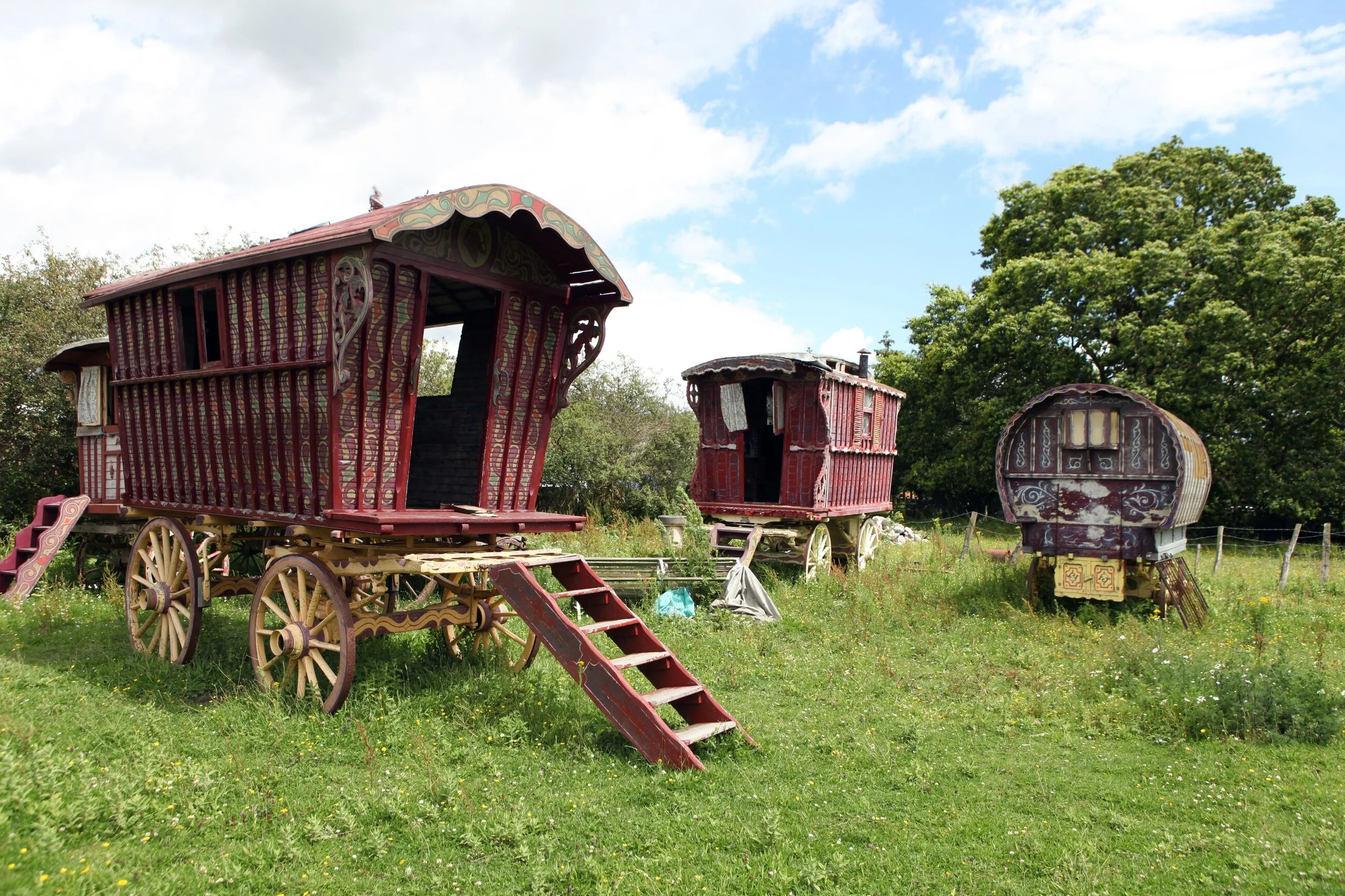
The Romani are the original proof that you can build a rich, enduring human culture not around a fixed place, but around the act of moving through the world together. Their wagons are ancestors of our vans. Their fire circles are ancestors of our campsite gatherings. Their portable trades are ancestors of our remote work setups.
We may be new to this road. But we are not the first ones on it.
Share this story & tag us — we want to hear what piece of nomadic history resonates most with you.
#NomadicByNature #RomaniHistory #VanLife #NomadCulture #BornToWander #RoadLife